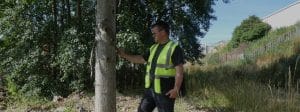

Are trees contributing to subsidence at your Surrey property?
We provide clear, evidence-led subsidence reporting that helps insurers, engineers and planners understand risk, avoid assumption and progress matters without unnecessary dispute.
Calls answered in 2 rings, emails replied to within the hour.
Clear guidance before you commit.
Working in partnership with clients to ensure planning approval first time
Industry Leading Standard
We stay with you from first call through to submission.
If you’re a homeowner, a subsidence report may be needed where cracking, movement or insurer queries are linked to nearby trees. Lenders often request independent arboricultural evidence before progressing mortgages or claims.
If you’re a developer or consultant, Surrey LPAs, insurers or structural engineers may require a subsidence report where retained trees interact with foundations, drainage or ground conditions. Early clarity avoids escalation, delays or inappropriate tree removal.
A short review usually confirms whether a full subsidence assessment is required — and just as importantly, when it isn’t.
Across Surrey, subsidence risk associated with trees commonly arises where:
High plasticity clay soils coincide with mature trees
Historic movement has been recorded in older residential areas
Trees sit close to shallow foundations or drainage runs
Seasonal cracking appears during dry summers
Insurers require confirmation before reinstating cover
A subsidence report helps assess actual tree influence.
We deliver Subsidence Reports for properties across Guildford, Woking, Reigate and the wider Surrey area, supporting insurers, lenders and homeowners.
In Surrey, subsidence-related tree evidence is scrutinised where foundation design, soil conditions and retained trees intersect. Planning officers assess whether root influence has been properly evaluated, whether soil shrink–swell risk has been addressed, and whether proposed foundations are proportionate to the actual level of risk. Subsidence reporting aligns with arboricultural guidance, NHBC principles, insurer requirements and, where planning is involved, BS 5837 and the Town and Country Planning Act 1990.
Clear evidence supports proportionate decisions without unnecessary tree removal or prolonged investigation.
Each site presents different constraints, and whilst local context informs risk, the outcomes depend on proportionate, site-specific evidence. Our Subsidence Reports deliver clear, balanced, evidence-based guidance.
We provide a planning-focused output for every Surrey site. This typically includes:
Clear assessment of tree influence and subsidence risk
Balanced conclusions without speculation or alarmism
Evidence suitable for insurers, lenders and engineers
Practical guidance aligned with planning and risk context
Where appropriate, findings can be aligned with tree surveys, AIAs or mortgage reports to avoid duplication.
Assessment of location, tree proximity, building age and reported issues.
Review of tree species, size, distance, soil conditions and structural context.
We assess likely tree influence alongside alternative causes such as drainage or construction type.
Integration into wider tree, planning or development assessments where relevant.
Concerned about subsidence in Surrey?
Send us your site details and we’ll confirm what level of assessment is required.
In Surrey, early signs of subsidence often include small cracks around windows and doors, doors beginning to stick, and slight unevenness in floors. These changes can become more noticeable during prolonged dry periods, particularly in areas with shrinkable clay soils.
Surrey has extensive areas of clay soil, particularly in locations such as Guildford, Woking, and Epsom. These soils are sensitive to moisture changes, meaning that ground movement can occur when trees draw water from the soil during dry weather.
Yes, trees can contribute to subsidence where they are located close to buildings and growing in moisture-sensitive soils. In Surrey’s residential areas, mature trees can significantly influence ground conditions by extracting moisture from the soil.
A tree subsidence report includes an assessment of nearby trees, soil behaviour, and visible structural movement. It evaluates whether tree roots are influencing ground stability and provides a clear, evidence-based conclusion suitable for planning, insurance, or structural purposes.
Where trees are close to proposed development or where subsidence risk is identified, supporting information may be required. Local Planning Authorities, such as Surrey County Council and borough councils, may request arboricultural input to support planning applications.
Subsidence risk can vary across Surrey depending on soil conditions. Areas with clay-rich ground, particularly across the north and west of the county, may be more susceptible to movement during periods of low soil moisture.
Tree-related subsidence is often identified through seasonal patterns, where cracks worsen during dry periods and stabilise when rainfall increases. This is assessed alongside tree proximity, soil behaviour, and structural observations.
No, most trees do not cause subsidence. Risk is typically associated with larger, high water-demand species located close to buildings, particularly where soil conditions are prone to shrinkage.
In some cases, managing a tree through pruning or monitoring may help reduce its impact on soil moisture levels. The most suitable approach depends on the species, size, and proximity of the tree, as well as the extent of the movement.
If you notice cracking or movement, it is important to arrange a professional assessment. A tree subsidence report will determine whether trees are contributing to the issue and provide clear recommendations, helping you take the right next steps for planning or property management.