Concerned a tree’s condition could become a safety or liability issue in Staffordshire?
We assess tree health objectively and proportionately, giving clear guidance that supports planning decisions, duty-of-care obligations and responsible management.
Calls answered in 2 rings, emails replied to within the hour.
Clear guidance before you commit.
Working in partnership with clients to ensure planning approval first time
Industry Leading Standard
We stay with you from first call through to submission.
If you’re a homeowner, you may need a Tree Health Survey where a mature tree shows signs of decline, disease, instability or damage close to a house, driveway or boundary. Insurers, lenders and local authorities often request independent evidence before decisions are made.
If you’re a developer or landowner, Tree Health Surveys are commonly required where retained trees influence layout, access, safety or long-term site viability. Early clarity avoids unnecessary retention assumptions, late redesign or post-consent complications.
A Tree Health Survey provides a clear, professional view of tree condition, risk and realistic management options.
Across Staffordshire, tree health concerns most often arise where mature trees sit within active residential, commercial or infrastructure settings. Common local contexts include:
Established housing areas in Stafford, Stone and Newcastle-under-Lyme where ageing boundary trees overhang neighbouring properties
Roadside and access corridors around Cannock, Burton-upon-Trent and Lichfield where declining trees raise safety or visibility concerns
Semi-rural plots and village edges where unmanaged trees sit close to dwellings, garages or services
Sites with recent storm exposure across exposed upland and edge-of-settlement locations, increasing risk of structural weakness or failure
In these settings, tree condition is often tested not only for amenity value, but for ongoing safety, liability and management responsibility.
We carry out Tree Health Surveys across Lichfield, Tamworth, Burntwood and nearby communities, supporting landowners, developers and managing agents across Staffordshire.
Tree health can quickly become a material consideration where decline, disease or structural weakness creates risk to people, property or development proposals. Local authorities, insurers and landowners rely on clear arboricultural evidence to distinguish between trees that can be responsibly retained and those requiring intervention.
Under the Town and Country Planning Act 1990, trees may influence planning decisions where safety, amenity or future management is relevant. Where works are proposed, BS 3998 (Tree Work – Recommendations) provides the professional framework for appropriate arboricultural intervention, while BS 5837 may apply where tree condition affects layout, access or development feasibility.
Our Tree Health Surveys are commercially aware, proportionate and planning-led, designed to support real-world construction sequencing, access logistics and foundation strategy without unnecessary escalation.
Our Tree Health Survey typically provides:
Professional assessment of tree condition and structural integrity
Identification of disease, decline or defect risk
Practical management or remediation recommendations
Reporting aligned with Staffordshire LPA, insurer and lender expectations
Our experts provide clear decision-ready arboricultural evidence across Staffordshire.
Review of site details, concerns and any planning or insurance context.
Detailed inspection of tree condition, structure, vitality and defects.
Clear evaluation of safety, longevity and management implications.
Integration with other arboricultural or ecological surveys where required.
Need clarity on tree health in Staffordshire?
We’ll assess any risk thoroughly and help you move forward with confidence.
A tree health survey is often required where trees may influence a development proposal in Staffordshire. Local Planning Authorities such as Staffordshire County Council and district councils may request supporting arboricultural information to assess tree condition, safety, and constraints. Providing a survey early helps avoid delays during validation or decision making.
A tree health survey involves a detailed inspection of each tree’s condition, structure, and overall vitality. This includes identifying signs of disease, decay, structural weakness, and environmental stress. The findings are presented in a clear, professional report suitable for planning, safety, or land management purposes.
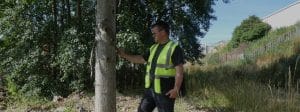
Tree health is assessed through a visual inspection carried out by a qualified arboricultural consultant. This includes reviewing crown condition, leaf quality, bark integrity, and any visible defects. Where concerns are identified, further investigation or monitoring may be recommended.
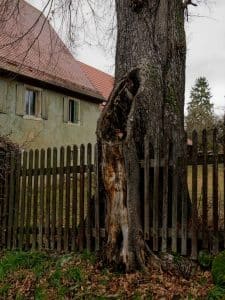
Common indicators include dead branches, fungal growth, cracks or splits in the trunk, leaning, or thinning foliage. Changes in tree condition over time can also signal underlying issues. Identifying these signs early helps reduce the risk of failure and allows for appropriate management.
A tree health survey is typically considered valid for a limited period, often around 12 to 24 months. However, this can vary depending on site conditions, weather events, and changes to the surrounding environment. Updated surveys may be required if conditions change.
A tree health survey is not always a legal requirement, but it is often expected in planning applications or where there are safety concerns. In Staffordshire, Local Planning Authorities may request supporting arboricultural information to ensure trees are properly assessed and managed.
In some cases, tree removal may require permission, particularly if the tree is protected by a Tree Preservation Order or located within a conservation area. A tree health survey provides professional evidence to support applications or justify works where safety is a concern.
A tree may be considered dangerous if it shows signs of structural instability, decay, or potential failure. Warning signs include large dead limbs, visible root disturbance, or significant trunk defects. A formal survey provides a clear assessment of risk and recommended actions.
The purpose of a tree health survey is to assess condition, identify risks, and provide clear management recommendations. This helps property owners, developers, and land managers in Staffordshire make informed decisions while meeting planning and safety expectations.
Most tree health surveys are completed within a single site visit, depending on the number and location of trees. The report is typically prepared shortly after, providing a clear and structured assessment for use in planning or ongoing management.