What Planning Services do we offer at ProHort?

Submitting a planning application can be a headache. Here at ProHort we offer a vast range of planning services therefore we can assist with all of your planning needs.

Planning Services in Addition to Tree Surveys:

Planning often request Tree Surveys with any of the following additional reports, we can provide all of these reports:

Other Planning Services: 

Furthermore, there are a range of additional reports and planning services we offer to ensure your development runs smoothly. These include but are not exclusive to the following: 


How We Can Help

ProHort provide a wide range of horticulture, arboricultural, ecological and landscape development services. The full list of our services can be found here. If you need any more information or are looking for a service not listed here, please contact us directly to discuss our services in more detail, we will be happy to help.  


We Are Social!

Why not check out our Facebook page and connect with us on Linked in?


Our Favourite Butterflies – Why Are They Beneficial To Our Gardens?

We don’t like caterpillars eating the plants in our gardens, however without them we wouldn’t have these beautiful butterflies. 

Here are some of our favourite species and ways they help the environment…

The Benefits of Butterflies in Our Garden:

1. They Pollinate the Plants in your Garden

Butterflies are great for your garden as they are attracted to bright flowers and feed on the nectar they produce. When feeding their bodies collect pollen and carry it to other plants. This helps vegetables, flowers and fruits produce new seeds. The majority of plants need pollinators like bees and butterflies to reproduce. 

2. They’re an Indicator of a Healthy Environment. 

A garden that attracts butterflies will also attract native birds and bees. Butterflies are great for the environment as they play an important role in increasing biodiversity. Unfortunately for butterflies and caterpillars they are a food source for birds, spiders, mice and other animals. Therefore, if butterfly population decreases the impact will be felt higher up the food chain and can affect the entire ecosystem. 

Some of Our Favourite Butterflies

Red Admiral:

A well-known colourful butterfly that can be found in Europe, Asia and North America. They have a wingspan of up to 2 inches. Red Admirals are quite friendly towards people, often perching on heads, arms and shoulders. Although it is not fan of farmers as their caterpillar like to feed on hops and other crops.  

Butterfly on bright pink flowers

Peacock Butterfly 

A regular visitor to our gardens, feeding on buddleia and other flowers. The Peacock butterfly is perhaps the most recognisable butterfly, has deep-red wings with black and blue ‘eyespots’. Its underside is dark brown, almost making their wings look like dead leaves. Their caterpillars particularly enjoy feeding on common nettles, therefore can often be found in woodland areas.

Comma Butterfly 

It has distinctive ragged wing edges, that help it to camoflague. As well as the brown and white flecks on their underwing that makes them look similar to bird droppings. The comma gets its name from the comma-shaped white spots underneath its wings. It prefers woodland edges but can be spotted feeding on fallen fruit in our gardens. 

Small Tortoiseshell Butterfly 

Common in our gardens where it feeds on buddleia and other flowers. The male butterflies are territorial, chasing other butterflies and anything else that is in their space. They court the female butterflies by drumming their antennae on the females’ hindwings. Their caterpillar mostly feed on nettles.

We Are Social!

Why not check out our Facebook page and connect with us on Linked in?

Tree Root Damage Survey

What is a Tree Root Damage Survey?

A tree root damage survey is designed to look at whether a tree has caused physical damage to either a property or other hard landscaped areas. This may include; foundations, underground pipes, walls, fences, tarmac, concrete or paved areas etc. A tree root damage investigation is particularly relevant if you are trying to identify if your tree or a neighbour’s tree has caused the damage.

We can also look at the potential damage a tree may cause in the future. This is a particularly useful survey for property management companies.

Who has a Tree Root Damage Survey?

The Tree Damage Assessment takes two different avenues, firstly the actual physical damage caused and secondly the potential damage a tree could cause in the future. As such we often have two different groups of people looking for a Tree Root Damage Survey – those who are sure a tree has already caused damage and those who are concerned a tree may cause damage in the future, (this maybe their own tree or a neighbours tree).

Our ‘Potential Tree Root Damage Survey’ is typically useful for the following three types of client:

  1. Homeowners who want to plant trees near a property.
  2. Property Management companies where they are responsible for the ongoing maintenance of a site.
  3. Landlords or homeowners that are concerned about a tree planted by a neighbour and its potential to cause damage.

For Property Management companies this type of survey can help tick your H&S box for trees especially if it is in connection to a ‘Tree Health Survey’.

What if my Neighbour Accepts No Liability?

Our reports are perfect if a neighbour’s tree has caused damage to your property fences and boundary walls. They are factual, simple to understand and clearly show where the liability is. We can also include accurate estimates for many types of remedial work.

If the neighbour fails to compensate you for the damage caused by their tree, we can write a Part 35 compliant report. This type of report is written in a way that is acceptable to the courts and will be needed by your solicitors if you decide to take the adjacent land owner to court.

Contact Us

For further advise or to book a Tree Root Damage Survey please ring us on 01782 479479 or contact us by email.

We are here to help so please do give us a ring any time as the phone will usually be answered between 7am and 9pm Monday to Friday and 8am to 8pm Saturday and Sunday.

Tree Root Damage Investigation

What is a Tree Root Damage Investigation?

A tree root damage investigation looks at whether or not a tree has caused any physical damage to either a property or other hard landscaped area. This includes; foundations, underground pipes, walls, fences, tarmac, concrete or paved areas etc. A tree root damage survey is particularly relevant if you are trying to identify if your tree or a neighbour’s tree has caused the damage.

We can also look at the potential damage a tree may cause in the future. This is a particularly useful survey for property management companies.

Who has a Tree Root Damage Investigation?

The Tree Damage Assessment takes two different avenues, firstly the actual physical damage caused and secondly the potential damage a tree could cause in the future. As such we often have two different groups of people looking for a Tree Root Damage Survey – those who are sure a tree has already caused damage and those who are concerned a tree may cause damage in the future, (this maybe their own tree or a neighbours tree).

Our ‘Potential Tree Root Damage Investigation’ is typically useful for the following three types of client:

  1. Homeowners who want to plant trees near a property.
  2. Property Management companies where they are responsible for the ongoing maintenance of a site.
  3. Landlords or homeowners that are concerned about a tree planted by a neighbour and its potential to cause damage.

For Property Management companies this type of survey can help tick health and safety boxes for trees especially when in connection to a ‘Tree Health Survey’.

What if my Neighbour Doesn't Accept Liability?

Our reports are perfect if a neighbour’s tree has caused damage to your property fences and boundary walls. They are factual, simple to understand and clearly show where the liability is. We can also include accurate estimates for many types of remedial work.

If the neighbour fails to compensate you for the damage caused by their tree, we can write a Part 35 compliant report. This type of report is written in a way that is acceptable to the courts and will be needed by your solicitors if you decide to take the adjacent land owner to court.

Contact Us

For further advise or to book a Tree Root Damage Survey please ring us on 01782 479479 or contact us by email.

We are here to help so please do give us a ring any time as the phone will usually be answered between 7am and 9pm Monday to Friday and 8am to 8pm Saturday and Sunday.
Root Protection Areas

What are Root Protection Areas?

These are normally in connection to tree surveys and the construction of an extension or a new build. As the name indicates the objective is to create an area where excavation does not take place or heavy construction traffic does not enter. By restricting the access of vehicles, the storage of materials and excavation within this area we are protecting the roots of the tree(s) and ensuring they are safe and free to flourish.

Root protection areas are always included in Tree surveys that are carried out to the British Standard 5837:2012. As qualified arboriculturists we have the added benefit of having years of experience dealing with Local Planning Authorities. For you this means we can ensure that everything is included in the report that your Local Planning Authority will require and that it is in a format that will satisfy their requirements. The benefit to you is that your planning permission will go through unhindered!

How Do You Calculate Root Protections Areas?

This is calculated from information gathered from the Tree survey, in particular the diameter of the trunk at 1.5m is a necessary measurement to calculate the RPA. To calculate the diameter, you measure the circumference of the tree and divide by 3.14156 (pi). This will give you the accurate diameter and you then multiply this by 12 to give you the radius of the RPA.

How We Lay Out Our RPA's:

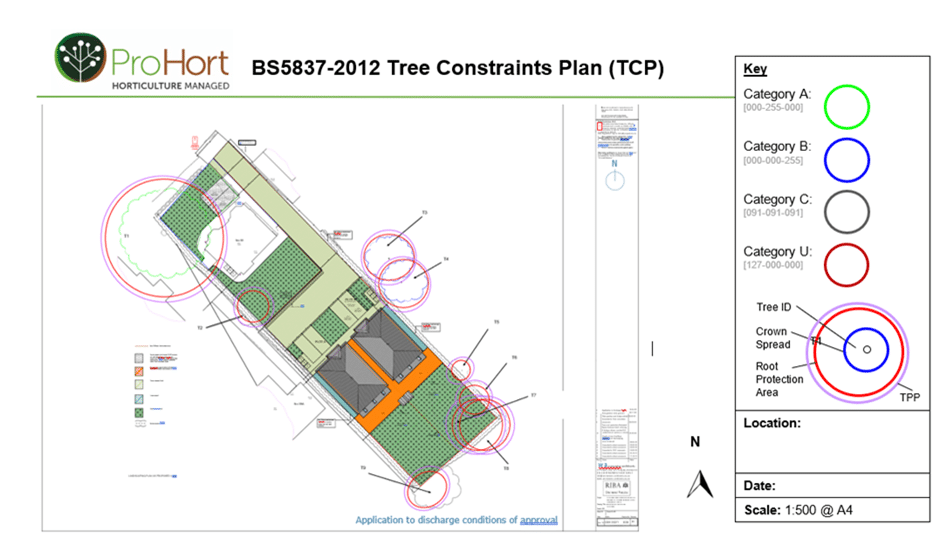
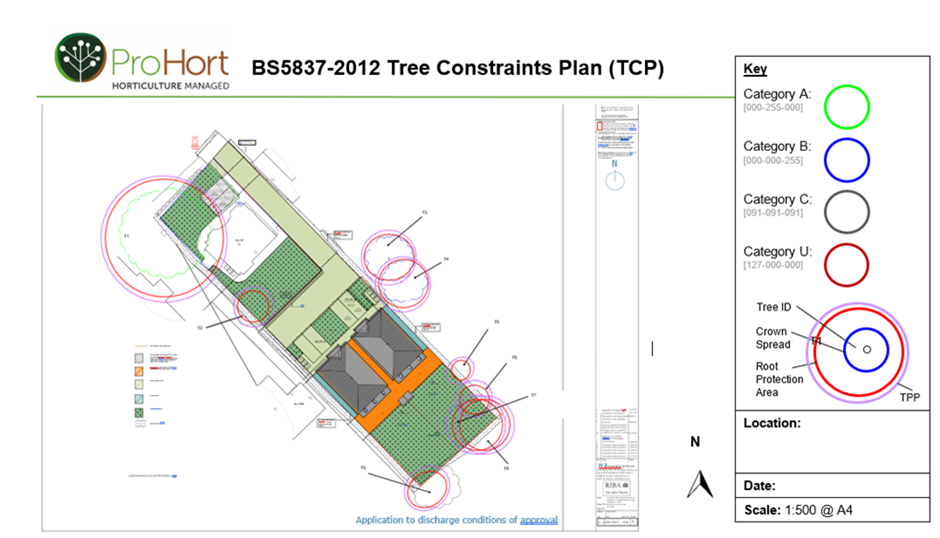
As can be seen below the trees are identified and placed on a Land registry title deed plan. We then overlap the “Crown spread” and this is colour coded to the Category of tree. The Root Protection Area is then laid on top of this. By doing this it clearly identifies the area that should not be accessed by machines, materials, or people excavating.

As this plan was for a Tree Subsidence report we have also included where we took the soil sample from.

Can I Build Over the Root Protection Zone?

There are a number of ways around this. Firstly, we could look at what the tree has been categorised as and whether it be removed. If the tree has been categorised as a C1 this means it has low value and there should be little reason as to why it cannot be removed. If the tree had been categorised as “B1” or “A1” tree it would be far more difficult to argue it should be removed.

Where the tree can not be removed and the proposed building works cannot be moved to outside the root protection area, we then need to work with the architect. There are certain types of foundation that are not recommended within the root protection area such as trench foundations. However other types of foundation such as pile foundations can work well. If digging is required to take place within the root protection area, we can use an air spade to ensure no damage to the root system occurs.

Contact Us for More Information on Root Protection Areas:

If you need a Tree survey or a report identifying the Root Protection Area then please do get in touch on 01782 479479 or email us email us on: [email protected].

Tree Constraints Plan

What is a Tree Constraints Plan?

Tree constraints plans (TCP) are usually part of the Tree survey which is carried out to the BS 3857:2012 standard. The information is usually displayed upon a plan and within a chart, the plan is drawn using CAD and this is then layered directly on to a topographical site survey. It would include the; Tree locations, Root Protection Area, Crown spreads, along with pictures of the trees in relation to the site.

Why Are Tree Constraints Plans Useful?

The dimensions of all the trees are included within the chart and these are then plotted onto the plan. This enables a realistic shape of each tree to be plotted, additionally the root zone is also plotted along with a root protection area around each tree. This in turn assists the architects when setting out their building, roadways, other hard paved areas and street furniture.

As part of the Tree constraints plan we would categorise each tree from A to C and U if the tree is dead or needs to be removed immediately. Trees that are categorised as “A” are excellent specimens and add significant amenity value or are particularly rare. Category ”B” trees are those that are not quite to the same standard as a “A” tree but are nevertheless important trees within the landscape, add a good amount of amenity value and have a significant life span and as such would ideally be kept. Category “C” trees are low in value, or may have a significant defect with limited life span.


Please see below for a typical Tree Constraints Plan:

Contact Us For a Tree Constraints Plan Today!

If you need any assistance or advice with regards a Tree Constraints Plan especially if required for planning permission. Please do get in touch on 01782 479479 (Head Office) or drop us an email on: [email protected]

Other Articles You Might Like...

Tree Protection Plan

What is a Tree Protection Plan?

You need a Tree Protection Plan when applying for planning permission as this will always be required by the town planners. 

The purpose of the Tree Protection Plan (TPP) is to illustrate all the trees that are to be retained. This would include accurately showing the spread of the trees to the four cardinal points (North, East, South & West). It would also include showing where the protective fencing would be erected so as to protect the trees roots and canopy.


See below example of a TPP as part of a tree survey to the B5837:2012 standard:

How do I Know if a Tree Has a TPO (Tree Protection Order)?

The first way is to take a look at the actual tree, often they have a silver metal tag attached to the tree to identify them with a number. As this is not always the case, you can then check the council website as some councils will have a web page with all trees that have a TPO on them identified on a virtual map. The final way is to make direct contact and request the information in writing.

How Close Can I Dig to a Tree That Has a TPO?

On the TPP you can see a black line outlining the Tree Protection Fencing. The objective of that fencing is to stop any digging within the area called the “Root zone.” The root zone is calculated, the figures are put into the Tree survey and that information is then laid out visually on the Tree Protection Plan. If a tree has a TPO this will influence the design of the building and where it is situated. Typically, the Town planners would not allow the removal of a tree with a TPO.

What happens if I Cut Down a Tree With a TPO?

We have known developers cut down trees with a TPO as they felt impacted significantly with their development. We would not recommend this course of action as by felling a TPO tree this can mean you are fined up to £20,000. If you carry out some work or damage a tree with a TPO without permission then this can result in a fine of £2,500. 

If work needs to be carried out on any tree but especially one with a TPO on it we can assist by applying on your behalf,, filling out all the necessary applications and giving well thought out reasons that the work is required so as to ensure a successful application.


Contact Us:

If you have any questions with regards Tree Protection Plans and Preservation Orders please give us a ring on: 01782 479479 (Head office) or contact us.


Why not follow us on Facebook to stay up to date with our latest news.

Other Articles You Might Like...

Construction Exclusion Zone

What is a Construction Exclusion Zone?

This involves us creating a plan of any and all trees both on and off the site that could be affected by the construction of the new project. This is different to a Tree protection plan which only identifies trees that can be impacted by the build itself. The Construction Exclusion Zone report and survey identifies trees that would be impacted, for example, at the entrance of the site or even along the roadway which may be 50m or more from the new build. 

The objective is to protect all the trees that may be potentially damaged or even have a small element of risk of being damaged during the construction phase. The risk may come from delivery lorries, parking of construction traffic, storage of materials within the root zone areas, chemical and diesel spills etc.  Planning officers sometimes request these documents as part of the Tree survey pack after the tree survey has been submitted. We find this is a significant factor in delaying planning and as such we would recommend supplying this report as a standard with the objective of ensuring the planning for your project is not delayed.

Next Steps...

Please give us a ring on 01782 479479 (Head office) or get in contact with us with us to discuss your project with you in detail to ensure we know exactly what you require, as well as what the Local Planning Authority have requested.

We will then be able to give you a quote for the work and as soon as you have paid the site survey is then booked in. Typically we conduct all site surveys within 2 working days and all reports are completed within two days of the survey.

We aim to provide great customer service which is why we have so many repeat clients. We look forward to speaking to you!

Why not follow us on Facebook to stay up to date with our latest news.

Other Articles You Might Like...

Ecology Surveys in Shrewsbury

What is an Ecology Survey?

Are you looking for an ecologist in Shrewsbury? Our ecology surveys in Shrewsbury are studies of the plants and animals in a specific area. This includes their interactions with each other and their habitat. An ecology survey is carried out by qualified professionals, such as ourselves, to create an inventory of the living organisms and ecological features in a particular area. The purpose of an ecology survey is to understand the dynamics of the ecosystem and to identify any potential impacts, risks or constraints of a development on the landscape and species living within it. This is to assist developers and the local planning authority in establishing what the next steps are to mitigate the impact on the environment.

What type of Ecology Survey do I need?

There are a range of surveys available, each is suited to a different scenario. They assess the impact that a development project may have on the surrounding environment and go into varying depths of detail depending upon the type of survey that you have.

Ecology surveys in Shrewsbury that ProHort Ltd can provide include but are not exclusive to the following:

  • Preliminary Ecological Assessment (previously called the Phase 1 Habitat).
  • Phase 1 Ecology Survey.
  • Phase 1 Extended Survey including Protected Species – Bats, Birds and Mammals.
  • NVC Vegetation Surveys (National Vegetation Classification)
  • UK Habitat Classification.
  • Habitat Regulation Assessments.
  • Ecology Mitigation Plans.
  • Biodiversity Net Gain Assessments including DEFRA.

How do I book my Ecology Survey?

Firstly, contact ProHort, we can provide you with a written quote for the ecology surveys in Shrewsbury that you require. Upon the confirmation that you would like to proceed, our specialist ecology consultant will visit the site to carry out the survey or assessment.

Once the survey has been completed, our consultant will put together your documentation. This will clearly show the results from the survey. This documentation will be sent in the form of a PDF or a physical copy of the report, if required.

Contact Us Today for Your Ecology Survey in Shrewsbury!

To find out more about how ProHort can support your ecology surveys in Shrewsbury, get in touch with our friendly team today. We offer expert advice, efficient survey scheduling, and detailed ecological assessments tailored to your project’s needs.

Whether you’re a developer, landowner, or planning consultant, we’re here to guide you through every stage of the process — from preliminary ecological appraisals to protected species surveys and mitigation strategies.

Call us on: 01782 479 479
Email: [email protected]

Let’s work together to ensure your project meets ecological and environmental requirements while maintaining sustainable development goals.

Natural Flood Management

In September 2023 the UK Government’s Department for Environment, Food & Rural Affairs (Defra) unveiled a £25m funding programme to support dozens of projects that are centred around natural processes. This has been done to help mitigate the risk of flooding as a result of climate change.

What is Natural Flood Management? 

Natural flood management (NFM) uses natural processes to reduce the risk of flooding. These processes protect, restore and mimic the natural functions of catchments, floodplains and the coast to slow down and store water. These include:

– Soil & Land Management – which will slow & store surface water run-off while also reducing soil erosion.

– River and Floodplain Management 

– Woodland Management – introducing hedgerow and woodland which will support wetland complexes and the creation of new habitats.

– Run-off Management – such as leaky barriers, wet woodlands, ponds and wetlands to help slow and store high flows in upper catchments, reducing the chance and impact of flooding downstream.

– Coast & Estuary Management – expansion and enhancement of saltmarsh and sand dune systems that naturally break wave action and reduce the risk of tidal flooding to local communities. 

NFM can also provide wider benefits including enhancing habitats and biodiversity. As well as improving water quality and the availability of drinking water. 

Benefits of Natural Flood Management: 

– Improves water quality & availability of drinking water
– Protect homes & businesses from flooding and coastal changes

– Enhances Habitats & Biodiversity

Research published last year indicated annual damage caused by flooding in the UK could increase by more than 20% due to the increasing severity of the climate crisis if national pledges to reach net-zero made at COP26 are not met in full.


Work will take place on these projects between now and 31 March 2027.  This will involve a range of organisations including:


– Wildlife Trusts 
– River Trusts
– Local Authorities
– Farmers
– Landowners.