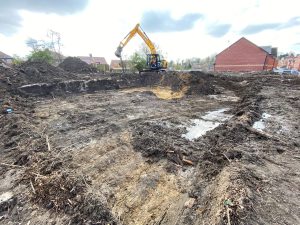

How will soil conditions shape planning, design and risk management across your Wales site?
Our soil testing service provides clear, lab-verified evidence on composition, contamination and suitability. We translate results into practical recommendations developers, architects and contractors can act on from day one.
Calls answered in 2 rings, emails replied to within the hour.
Clear guidance before you commit.
Working in partnership with clients to ensure planning approval first time
Industry Leading Standard
We stay with you from first call through to submission.
If you’re building, extending or altering land in Wales, soil analysis provides the evidence architects and engineers need to design foundations, drainage and risk mitigation accurately.
We deliver fast, planning-ready results that remove guesswork and help keep construction choices efficient.
Across Wales, planning and engineering requirements emerge from complex terrain and legacy land use, including:
Clay-rich valley floors, increasing shrink–swell and settlement risk
Sloping ground and shallow bedrock, influencing foundation depth
River alluvium within valley systems, affecting permeability and flood response
Former mining land, where stability and contamination screening are essential
Ground conditions frequently shape design feasibility and planning evidence.
Our soil testing and analysis service is delivered across Wales and its surrounding districts, supporting planning, design and land quality assessment for homes, developments and large construction projects.
Soil data interacts with multiple planning requirements:
NHBC foundation guidance & shrink–swell tables
BS 5930 Site Investigation Standard
Contaminated land policy & Environmental Protection Act principles
Accurate soil classification reduces structural risk and avoids unnecessary over-engineering.
Our Soil Analysis Reports in Wales give developers, designers and landscapers reliable baseline data that informs planting plans, remediation strategies and specification choices with confidence.
You collect the sample using the ProHort sampling kit and instructions.
The sample is returned to ProHort via our courier.
(Includes the full Core Package)
Adds professional interpretation of laboratory data, showing how results compare with accepted standards.
(Includes Core + Analytical)
A ProHort expert attends site, undertakes sampling and conducts a visual assessment of factors influencing soil behaviour.
Our team is here to guide you throughout the process.
Need soil testing in Wales?
Share your address and goals and we’ll confirm testing scope immediately.
The laboratory analysis itself may be similar, but the planning, environmental and regulatory context can differ.
Developments in Wales are considered within the Welsh planning system, while Natural Resources Wales has responsibilities relating to matters including land contamination, controlled waters, groundwater and environmental protection.
The testing required should therefore reflect not only the condition and history of the site but also the purpose of the investigation and any requirements imposed by the relevant Welsh Local Planning Authority or environmental regulator.
Natural Resources Wales may be consulted on planning applications involving potentially contaminated land where pollution could affect controlled waters. It may also be relevant to developments involving groundworks near historic, closed or active landfill sites and certain other environmentally sensitive proposals.
Soil testing can provide important evidence about contaminants present within a site, although laboratory analysis may form only one part of a wider land contamination assessment.
Where planning or environmental requirements apply, the scope of investigation should be designed around the risks associated with the individual site.
Yes. Soil analysis can assess characteristics relevant to agricultural, horticultural and land management decisions, including soil pH, nutrients, organic matter and other appropriate parameters.
This is particularly useful where landowners need a clearer understanding of existing soil conditions before making decisions about planting, soil improvement or nutrient management.
Welsh soils vary considerably according to geology, land use, climate and management history, so laboratory results provide site-specific evidence rather than relying on assumptions about soil quality.
Phosphorus is an important plant nutrient, but excessive levels can contribute to environmental problems where phosphorus is lost from land and enters watercourses.
Natural Resources Wales’ latest assessment of Welsh soils identifies increasing phosphorus enrichment as a concern on improved land, with more monitored sites exceeding leaching thresholds.
Testing can help establish the nutrient status of soil and support informed decisions about land and nutrient management. However, soil phosphorus testing should not be confused with a nutrient neutrality assessment required for certain developments affecting nutrient-sensitive protected rivers.
Yes. Wales has a substantial history of mining, quarrying, metal processing and heavy industry, and some previously developed sites may contain contamination associated with their historic use.
The appropriate testing depends on the specific history of the land. Potential contaminants can vary considerably between former collieries, metal mining areas, industrial premises, fuel sites and other brownfield land.
A site-specific approach is therefore preferable to automatically applying the same laboratory testing suite to every former industrial site.
Where contamination could affect a development, the relevant Local Planning Authority will consider whether sufficient information has been provided to demonstrate that the site can be made suitable for its proposed use.
Natural Resources Wales also provides guidance for developers dealing with land contamination and advises on circumstances where it should be consulted during the planning process.
Current guidance for developers in Wales can be found at:
Any site-specific planning conditions or requests from the Local Planning Authority should also be considered when determining the scope of soil testing.
Yes. Contaminants within soil do not necessarily remain where they originated. Depending on ground conditions and the contaminant involved, substances can potentially migrate and affect groundwater, rivers or other controlled waters.
This is one reason the location and environmental setting of a development are important when investigating potentially contaminated land.
Natural Resources Wales specifically identifies potentially contaminated development that may pollute controlled waters as a circumstance where it may need to be consulted. Laboratory soil analysis can contribute to understanding the potential source of contamination, although additional groundwater or wider environmental investigation may sometimes be required.
Potentially. Farm diversification can introduce new uses such as residential accommodation, tourism facilities, commercial buildings or other activities onto land previously used solely for agriculture.
Where development affects former yards, workshops, fuel storage areas, chemical storage locations or other potentially contaminative uses, soil testing may help establish whether further investigation is required.
For agricultural developments, nutrient and soil condition testing can also have a separate role. It is important to distinguish between testing for agricultural soil quality and investigation of potential land contamination because they address different questions.
Soil and contamination information can be relevant when Sustainable Drainage Systems, or SuDS, are being designed for previously developed land.
Natural Resources Wales advises that contamination does not automatically prevent infiltration drainage from being used on a brownfield site. However, the location of contaminated material and the potential for infiltration to mobilise pollutants need to be considered as part of the design and remediation strategy.
Soil contamination results can therefore contribute useful information, although drainage design, infiltration testing and approval of the SuDS scheme are separate processes.
Yes. ProHort can provide Soil Testing & Analysis for projects throughout Wales, including North Wales, Mid Wales, South Wales and the Welsh Borders.
Testing can support residential and commercial development, agricultural and horticultural land, landscaping projects, brownfield sites and investigations into potentially contaminated soil.
The appropriate laboratory suite can be selected according to the site’s location, history and proposed use, helping ensure the testing is proportionate to the reason it has been commissioned.