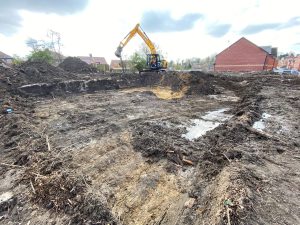

How will soil conditions shape planning, design and risk management across your Sussex site?
Our soil testing service provides clear, lab-verified evidence on composition, contamination and suitability. We translate results into practical recommendations developers, architects and contractors can act on from day one.
Calls answered in 2 rings, emails replied to within the hour.
Clear guidance before you commit.
Working in partnership with clients to ensure planning approval first time
Industry Leading Standard
We stay with you from first call through to submission.
If you’re building, extending or altering land in Sussex, soil analysis provides the evidence architects and engineers need to design foundations, drainage and risk mitigation accurately.
We deliver fast, planning-ready results that remove guesswork and help keep construction choices efficient.
Engineering considerations across Sussex reflect varied geology and topography, including:
Weald clay landscapes, presenting shrink–swell challenges
Chalk and sandstone formations, influencing bearing capacity
River terrace and coastal deposits, affecting drainage performance
Previously developed land, where historic contamination must be assessed
These conditions directly influence foundation and drainage design.
Our soil testing and analysis service is delivered across Sussex and its surrounding districts, supporting planning, design and land quality assessment for homes, developments and large construction projects.
Soil data interacts with multiple planning requirements:
NHBC foundation guidance & shrink–swell tables
BS 5930 Site Investigation Standard
Contaminated land policy & Environmental Protection Act principles
Accurate soil classification reduces structural risk and avoids unnecessary over-engineering.
Our Soil Analysis Reports in Sussex give developers, designers and landscapers reliable baseline data that informs planting plans, remediation strategies and specification choices with confidence.
You collect the sample using the ProHort sampling kit and instructions.
The sample is returned to ProHort via our courier.
(Includes the full Core Package)
Adds professional interpretation of laboratory data, showing how results compare with accepted standards.
(Includes Core + Analytical)
A ProHort expert attends site, undertakes sampling and conducts a visual assessment of factors influencing soil behaviour.
Our team is here to guide you throughout the process.
Need soil testing in Sussex?
Share your address and goals and we’ll confirm testing scope immediately.
Soil testing can be required where the quality or previous use of land creates uncertainty about whether it is suitable for a proposed development.
This may include former commercial or industrial sites, previously developed land, sites containing made ground and plots where potentially contaminative activities have taken place.
Laboratory analysis can provide evidence about substances present within the soil and help determine whether further investigation, risk assessment or remediation is required.
Potentially. Coastal and urban sites can have complicated histories, particularly where land has previously accommodated industry, workshops, storage areas, infrastructure or imported fill.
The fact that a property is near the coast does not automatically mean its soil is contaminated. The important consideration is the individual site’s history and environmental setting.
Where a potential source of contamination has been identified, targeted soil testing can provide more useful evidence than commissioning a broad laboratory suite without first understanding the site.
Yes. Where commercial land is being converted or redeveloped, particularly for housing, gardens or another more sensitive use, its previous activities should be considered.
Former workshops, garages, depots, fuel storage areas and certain industrial premises can potentially leave contaminants within the ground.
Appropriate soil testing can help establish whether these substances are present and whether the results require further assessment before the proposed development proceeds.
Groundwater can be an important consideration because contaminants in soil may, under certain conditions, migrate through the ground and affect water beneath or beyond a site.
Sussex contains important groundwater resources, including areas associated with chalk aquifers. Where a development is environmentally sensitive, understanding the relationship between potential contamination and controlled waters can therefore be important.
Soil testing can contribute to the investigation, although groundwater monitoring or other specialist assessments may be required where risks to controlled waters need to be examined directly.
Yes. Soil analysis can be useful where lawns, trees, shrubs, planting beds or other vegetation are performing poorly and the cause is not immediately apparent.
Testing can assess factors such as pH, nutrients, organic matter and other relevant soil characteristics. This can help identify whether soil conditions could be limiting plant establishment or growth.
Laboratory analysis is particularly useful because symptoms such as weak growth or discolouration can have several possible causes and are not always the result of a nutrient deficiency.
There is no single soil type across Sussex. Soil characteristics vary considerably according to underlying geology, location, drainage and previous land management.
Some areas associated with chalk geology can have alkaline conditions, while soils elsewhere may be more acidic. This variation can influence nutrient availability and which plants are best suited to a particular site.
A laboratory soil test provides site-specific information about pH and other relevant characteristics rather than relying on assumptions based solely on the property’s location.
This depends on where the development is located because Sussex is covered by several Local Planning Authorities rather than a single planning authority for the entire area.
For example, developments in East Sussex may fall within areas administered by councils such as Lewes, Wealden, Rother or Eastbourne, while West Sussex includes authorities such as Horsham, Chichester, Crawley, Mid Sussex, Adur and Worthing. Brighton & Hove has its own planning authority.
East Sussex County Council’s planning information can be found at:
https://www.eastsussex.gov.uk/planning
Applicants should ultimately follow the requirements of the Local Planning Authority determining their particular application, including any conditions or requests relating to contaminated land.
Testing can be valuable where imported topsoil will be used in residential gardens, landscaped areas or other sensitive locations, particularly where its source or previous use is uncertain.
Depending on the project, analysis may investigate characteristics affecting plant growth as well as potential contaminants.
Testing imported material before widespread placement can also provide useful evidence about its condition and may reduce the risk of discovering unsuitable soil after landscaping has been completed.
Yes. Understanding soil pH and nutrient status can help inform plant selection and soil improvement decisions.
For example, plants adapted to acidic conditions may perform poorly in strongly alkaline soil, while other species are well suited to calcareous conditions associated with chalk.
Soil analysis should not replace consideration of drainage, sunlight, exposure and available rooting space, but it can provide objective information that helps landscape designers, gardeners and landowners make better informed planting decisions.
ProHort provides Soil Testing & Analysis across East Sussex and West Sussex, including Brighton and Hove, Eastbourne, Hastings, Lewes, Uckfield, Crowborough, Chichester, Horsham, Crawley, Worthing, Haywards Heath, Burgess Hill and surrounding areas.
Testing can support planning and development projects, contaminated land investigations, landscaping schemes, gardens and other situations where reliable information about soil condition is required.
The testing suite can be selected according to the site and reason for investigation, helping ensure the laboratory analysis addresses the relevant question rather than applying unnecessary tests.