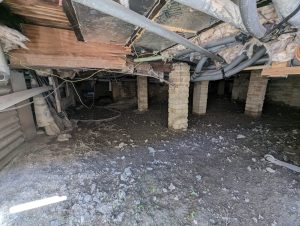
Preliminary Roost Assessment (PRA) in Dudley
Worried that bats could affect your planning application in Dudley?
Our specialist PRAs give you early, reliable insight into ecological constraints, keeping your project on track and compliant.
Fast, Clear, Planning-Ready Support
Fast response
Calls answered in 2 rings, emails replied to within the hour.
Free expert advice
Clear guidance before you commit.
Cost-effective
Working in partnership with clients to ensure planning approval first time
Typical 10-day turnaround
Industry Leading Standard
Expert Team
We stay with you from first call through to submission.
Do you Need a Preliminary Roost Assessment (PRA) in Dudley?
For homeowners, a PRA is typically required when roof works, loft conversions, extensions, or structural alterations interact with buildings that could provide access or shelter for bats. Dudley Council often requests confirmation that bats are not present before granting planning consent.
For developers, PRAs are necessary when existing structures, trees, bridges, or retained features form part of a planning submission. Council planners rely on PRA evidence to determine whether further surveys are needed to meet legal requirements. This applies to residential developments, conversions, brownfield regeneration projects, and infrastructure works.
Early assessment at the PRA stage reduces the risk of seasonal delays, redesigns, and unexpected licensing obligations.
Across Dudley, Preliminary Roost Assessments are most commonly requested where development interacts with:
- Older housing stock in areas such as Brierley Hill, Sedgley, Netherton and Stourbridge, where lofts, ridge tiles, and masonry gaps may provide potential roosting features
- Redundant outbuildings, barns, and detached garages across the semi-rural edges of Dudley borough, including Kinver, Claverley, and Gospel End
- Brownfield and regeneration sites in areas like Halesowen, Tipton, and Dudley town centre, where legacy structures are retained within redevelopment schemes
- Linear habitats and green corridors, including the River Stour, canals such as the Staffordshire & Worcestershire Canal and Dudley Canal, as well as hedgerows and treelines intersecting development sites
PRAs are routinely checked at validation whenever any level of bat potential exists.
Our PRA services cover all of Dudley borough and surrounding neighbourhoods.
Why Dudley Planning Authorities Request Preliminary Roost Assessments
Dudley Council requires PRAs wherever buildings, trees, or structures present potential roosting opportunities in line with the Wildlife & Countryside Act 1981, the Conservation of Habitats and Species Regulations 2017, and national planning policy. Without a PRA, planners cannot lawfully decide whether dusk emergence surveys or protected-species licences are needed. Missing evidence often results in validation delays, additional planning conditions, or seasonal waiting periods.
Where a Dudley project involves demolition, roof replacement, conversion, or structural alterations, PRA evidence should be obtained before submitting the planning application.
Local Case Insight
The Preliminary Roost Assessment Process
Our Preliminary Roost Assessments in Dudley provide fully compliant reports accepted by local planning authorities. It prevents avoidable emergence delays, stabilises planning submissions and ensures that any further survey requirements are proportionate and justified.
Key Deliverables for Birmingham Projects
Where bat scoping is needed to support planning in Dudley, a PRA provides:
- a legally compliant preliminary roost assessment report
- confirmed roost-potential classification
- clear determination of whether dusk emergence surveys are required
- early understanding of licensing requirements
- documentation formatted for Dudley Council and neighbouring LPAs
The outcome: clarity and controlled project risk.
Step 1
Programme & Scoping
Proposed works, construction sequence and planning feedback are reviewed to define PRA scope.
Step 2
Daytime Roost Inspection
Inspection of buildings, structures or trees for roost features and bat evidence in line with lawful survey guidance.
Step 3
Assessment
Roost potential classification and planning implications interpreted against LPA validation requirements.
Step 4
Reporting & Integration
Evidence is reported for planning submissions and coordinated with Bat Emergence Surveys or PEAs where required.
Next Steps
Need to confirm whether a Dudley property or development requires a Preliminary Roost Assessment?
Submit the site details and confirmation is provided before your application reaches validation.
FAQ - Preliminary Roost Assessments in Dudley
Do Dudley planning authorities require dusk emergence surveys for most roof works?
Not in all cases, but where roost potential is identified, the LPA usually requires a PRA before validation and may request dusk emergence surveys where risk remains.
Dudley Planning Links
- Dudley Council – https://www.dudley.gov.uk/planning
Can a PRA in Dudley be completed at any time of year?
Yes. PRAs are daytime inspections and can be completed year-round. Only dusk emergence surveys are subject to seasonal restrictions.
What happens after a Dudley PRA identifies low roost potential?
Even low potential usually triggers at least one dusk emergence survey before demolition or conversion works can be validated.
Does a PRA confirm that bats are absent in Dudley?
No. A PRA identifies risk and determines whether further surveys are required to establish bat presence or likely absence.
How long is PRA evidence valid for Dudley planning?
LPAs may request updated PRA evidence where building condition or surrounding habitat changes, or if more than 18–24 months have passed.
Is a PRA always required before a dusk emergence survey in Dudley?
Yes—unless robust, recent survey data already exists, a PRA is required to determine whether emergence surveys are needed.